General Information
Learn more about our conference, including key dates, location, and objectives.
First Information
Click on to find out more about our First Announcement.
Conference Overview
This conference brings together leading researchers in Active Galactic Nuclei (AGN) and Gravitational Lensing to discuss recent discoveries, methodologies, and future directions in observational astronomy.
The Aim
Investigation of the nature of the emitting ionized gas in active galactic nuclei (AGN) is one of important subjects in astrophysics today. Firstly, investigating the processes in the central region of these objects, we can learn about the innermost regions of other 'normal' galaxies. Secondly, AGN are the most powerful sources, located at different cosmological time-scales, and their research is cosmologically important. Finally, a part of emission from these objects (e.g. in the X-rays) has its origin very close to a supermassive black hole, and investigation of this emission can help us understand the physical processes in a strong gravitational field.
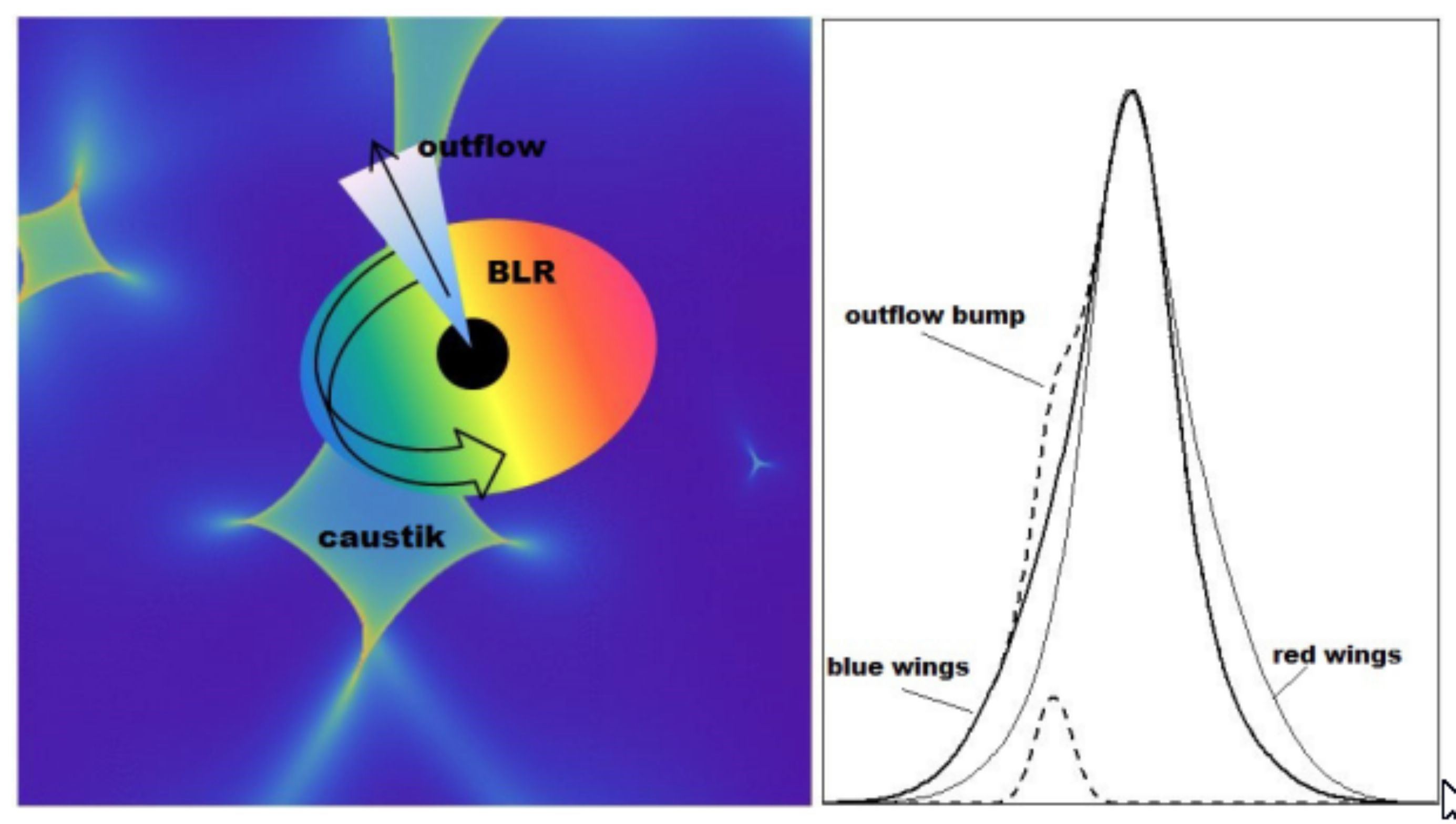
Analysis of the AGN spectra, the shapes of the broad and narrow emission lines and their relative intensities, give us an insight in complex structure, kinematics and physics of the AGN emission regions, as well as in numerous atomic processes in the line emission gas. Collisional processes could be significant in some parts of the AGN broad line emission region where many atoms are in excited states, because of the high electron density and large optical depth. Moreover, it is demonstrated that the increasing of turbulence cause the grow of the number of continuum photons that can be absorbed, which increases the population of excited particles, as well as the importance of collisional processes since such particles may undergo a collisional transition.
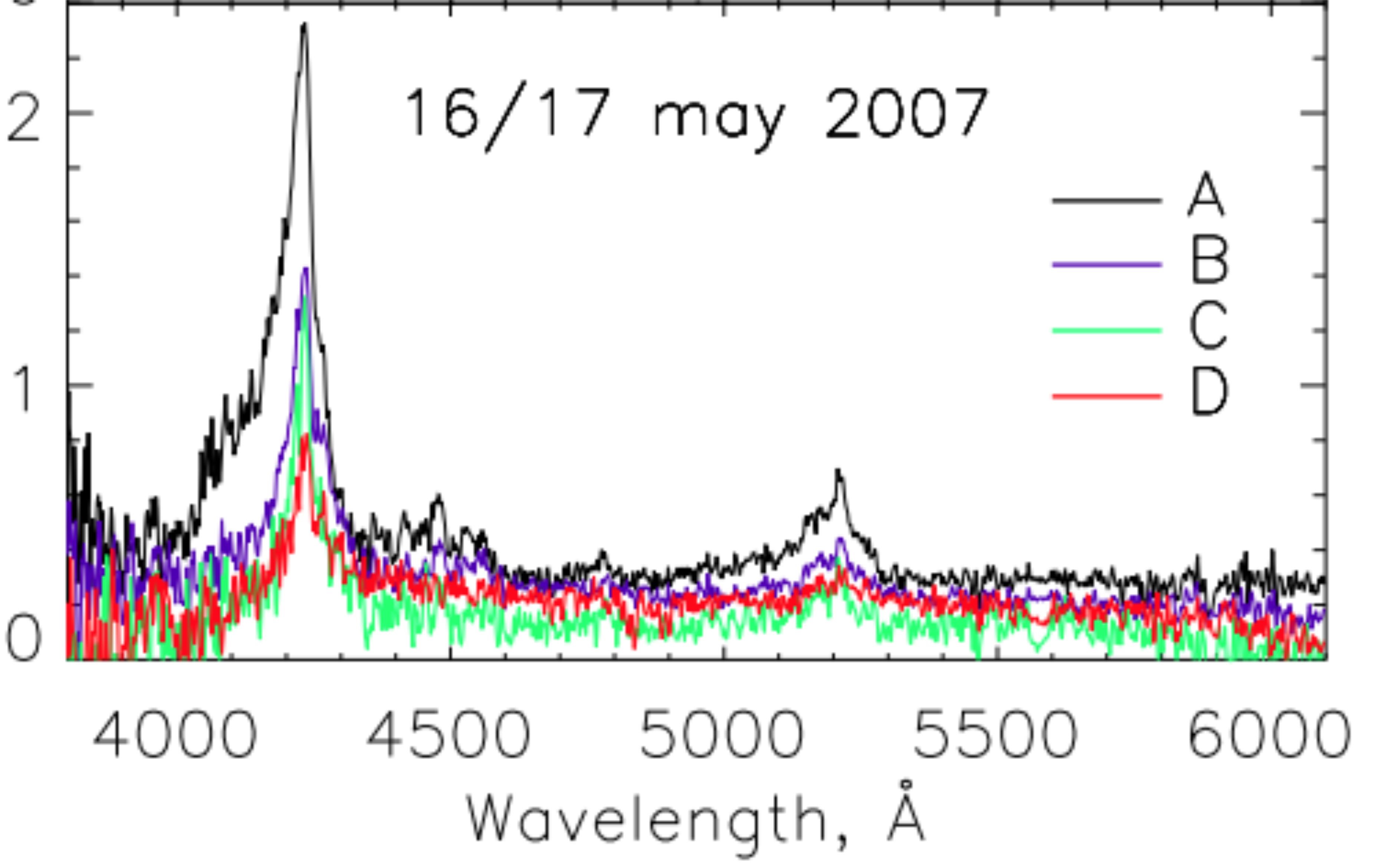
On the other hand, a number of AGN are affected by gravitational lensing effect. Gravitational lensing is in general achromatic: the deflection angle of a light ray does not depend on its wavelength. However, the wavelength-dependent geometry of the various emission regions may result in a chromatic effect. Studies aimed at determining the influence of microlensing on spectra of lensed quasars (hereafter QSOs) ought to account for the complex structure of the QSO central emitting region. Since the sizes of the QSO emitting regions are wavelength-dependent, microlensing by stars in a lens galaxy will lead to a wavelength-dependent magnification.
Key Dates
Registration deadline: February 28, 2026
Deadline for mini-project submission (100 words): February 28, 2026
Abstract submission deadline: February 28, 2026
Second Announcement: June 1, 2026
Final Announcement: July 1, 2026
Location
Hotel Vrnjačke Terme, Vrnjačka banja, Serbia
Scientific Organizing Committee
Co-Chairs:
• Luka Č. Popović (Astronomical Observatory Belgrade, Serbia)
• Saša Simić (Faculty of Science, University of Kragujevac, Serbia)
Members:
• Milan S. Dimitrijević (Astronomical Observatory, Belgrade, Serbia)
• Dragana Ilić (Faculty of Mathematics, University of Belgrade, Serbia)
• Predrag Jovanović (Astronomical Observatory, Belgrade, Serbia)
• Wolfram Kollatschny (Institute for Astrophysics, University of Goettingen, Germany)
• Andjelka Kovačević (Faculty of Mathematics, University of Belgrade, Serbia)
• Evangelia Lyratzi (University of Athens, Greece)
• Evencio Mediavilla (Instituto de Astrofísica de Canarias, Spain)
• Vladimir Srećković (Institute of Physics, Zemun, Serbia)
• Jian-Min Wang (Key Laboratory for Particle Astrophysics, Institute of High Energy Physics, China)
• Alexander Zakharov (Institute for Theoretical and Experimental Physics, Moscow, Russia)
• Gustavo E. Romero (Argentine Institute of Radio Astronomy, Buenos Aires, Argentina)
• Jelena Kovačević-Dojčinović (Astronomical Observatory, Belgrade, Serbia)
Local Organizing Committee
Chair:
• Saša Simić (Faculty of Sciences, Department of Physics, University of Kragujevac)
Members:
• Lazar Novićević (Astronomical observatory, Belgrade)
• Đorđe Savić (Astronomical Observatory, Belgrade, Serbia)
• Maša Lakićević (Astronomical Observatory, Belgrade, Serbia)
Organizing Institutions
Organizer:
Astronomical Observatory Belgrade, Volgina 7, 11060 Belgrade, Serbia
Co-organizer:
Faculty of Sciences, Radoja Domanovića 12, 34000 Kragujevac, Serbia
Proceedings
We are pleased to announce that as Proceedings:
The Special Issue of the journal Contributions of the Astronomical Observatory Skalnaté Pleso - (CAOSP Impact factor 0.200):
From stars to AGNs - line shapes and A&M data, with regular articles based on the contributions (lectures and posters) to VII Conference on Active Galactic Nuclei and Gravitational Lensing, will be published in the beginning of 2027.
The deadline for sending contributions is October 20, 2026.
The contributions should be sent in .pdf format to the regular conference email: agn_gl@pmf.kg.ac.rs, and Cc: to mdimitrijevic@aob.rs, lazarnovicevic@aob.rs
Once your paper is accepted, you will be asked to provide the manuscript in LaTeX format.
Instructions for preparing contributions are given at Author instructions website: here.
To prepare a manuscript, authors are required to use the LaTeX2e DocumentClass caosp.cls and to follow the instructions for preparing the manuscript demo_caosp.tex. In this file, you can find detailed instructions on the figures, table layout, captions, labels, etc.
The CAOSP LaTeX2e macro package can be downloaded from here. It comes with an example of a manuscript, BibTeX style, and other files you may need. You can find some practical instructions there. Authors are strongly encouraged to use BibTeX.
Electronic formats different from LaTeX will not be accepted.
Figures need to be in the preferred "*.eps" (encapsulated PostScript) or "*.pdf" (PDF) formats. The vector version of these formats is required. The bitmap version can be used only in unavoidable cases (photographs) and the managing editor should be consulted in advance.
Extended tables and other data (e.g. spectra in ASCII or FITS format) are published separately in a computer-readable form. Please, read the detailed instructions in the demo file on how to prepare such data. Their publication is important for reproducing the results in articles.
Each CAOSP article is published by the Astronomical Institute as an Open Access article, under the terms of the Creative Commons Attribution License: license link, which permits unrestricted use, distribution, and reproduction in any medium, provided the original work is properly cited.
Contact Us
Saša Simić – ssimic@uni.kg.ac.rs
Luka Č. Popović – lpopovic@aob.rs
Lazar Novićević - lazarnovicevic@aob.rs
Phone: TBD